
Flow
😀 Flow
-
Being in flow is good for us: "Flow is the experience of being deeply immersed in an activity, an experience that researchers have embraced as a predictor of well-being.... Results from a meta-analysis revealed a moderately strong, positive relationship between flow and well-being." ("Just Keep Flowing: A Meta-Analysis on the Relationship Between Flow and Well-Being," Emotion, 2026)
-
Being in flow seems protective against depression, anxiety, schizophrenia, bipolar, stress-related, and cardiovascular discorders: "In a large, longitudinal twin sample (N = 9361)... higher flow proneness had a decreased risk of receiving diagnoses for depression (16%; CI [14%, 18%]), anxiety (16%; CI [13%, 18%]), schizophrenia (15%; CI [4%, 25%]), bipolar (12%; CI [6%, 18%]), stress-related (9%; CI [9%, 12%]), and cardiovascular disorders (4%; CI [1%, 8%])." ("Can flow proneness be protective against mental and cardiovascular health problems? A genetically informed prospective cohort study," Translational Psychiatry, 2024)
-
We're most likely to reach flow state when our skills and the challenge we face are balanced, we have clear objectives, and we feel in control: "[A]] meta-analysis was conducted on 28 studies examining the challenge–skill balance related to flow and intrinsic motivation in a variety of contexts... [C]hallenge–skill balance was a robust contributor to flow along with clear goals and sense of control." ("The challenge–skill balance and antecedents of flow: A meta-analytic investigation," The Journal of Positive Psychology, 2014)
-
Passive leisure is where flow goes to die, and it's self-reinforcing: Experience sampling of 104 adult workers found television viewing to be a relatively unchallenging activity requiring little cognitive investment, consistently tied to relaxation, passivity, and drowsiness. People experienced far greater flow while reading than while watching television. ("Television and the Rest of Life: A Systematic Comparison of Subjective Experience," Public Opinion Quarterly, 1981) This can trigger a passivity death spiral because people with lower moods were more likely to watch much more evening television. Low mood → passive leisure → lack of flow → even lower mood. ("Television as escape: Subjective experience before an evening of heavy viewing," Communication Reports, 2009)
-
Work is the primary place people ordinarily experience flow: Even though "respondents are more motivated in leisure than in work," "the great majority of flow experiences are reported when working, not when in leisure." ("Optimal experience in work and leisure," Journal of Personality and Social Psychology, 1989)
Experts say we're most likely to achieve flow state (such a deep task focus that we lose track of time) when:
- 🧘 We have clear goals
- We're doing something challenging but not overwhelming
- We're doing something we find engaging
- We avoid distractions
- We're getting fast feedback

📽️ Videos
Flow by Mihaly Csikszentmihalyi: Animated Book Summary: FightMediocrity
How to Easily Enter Flow State Anytime You Want: Mind Mentor Podcast
How to enter flow state: Leah Putnam on TED-Ed
The science of effortlessness: How to activate flow: Steven Kotler on Big Think
The Quiet Formula Behind Peak Performance: The Inner Game
How to use ‘flow state’ to do the impossible: Steven Kotler on Big Think
Train Your Brain: Mindfulness Meditation for Anxiety, Depression, ADD and PTSD: Daniel Goleman on Big Think
Why Having Fun Is the Secret to a Healthier Life: Catherine Price on TED
Flow, the secret to happiness: Mihaly Csikszentmihalyi on TED
📰 Articles
- Flow (psychology): Wikipedia
- How to enter a state of flow: Susan A. Jackson, Psyche
- Finding Flow: Psychology Today
📚 Books
The Art of Impossible: A Peak Performance Primer by Steven Kotler
Book page: The Art of Impossible: A Peak Performance Primer
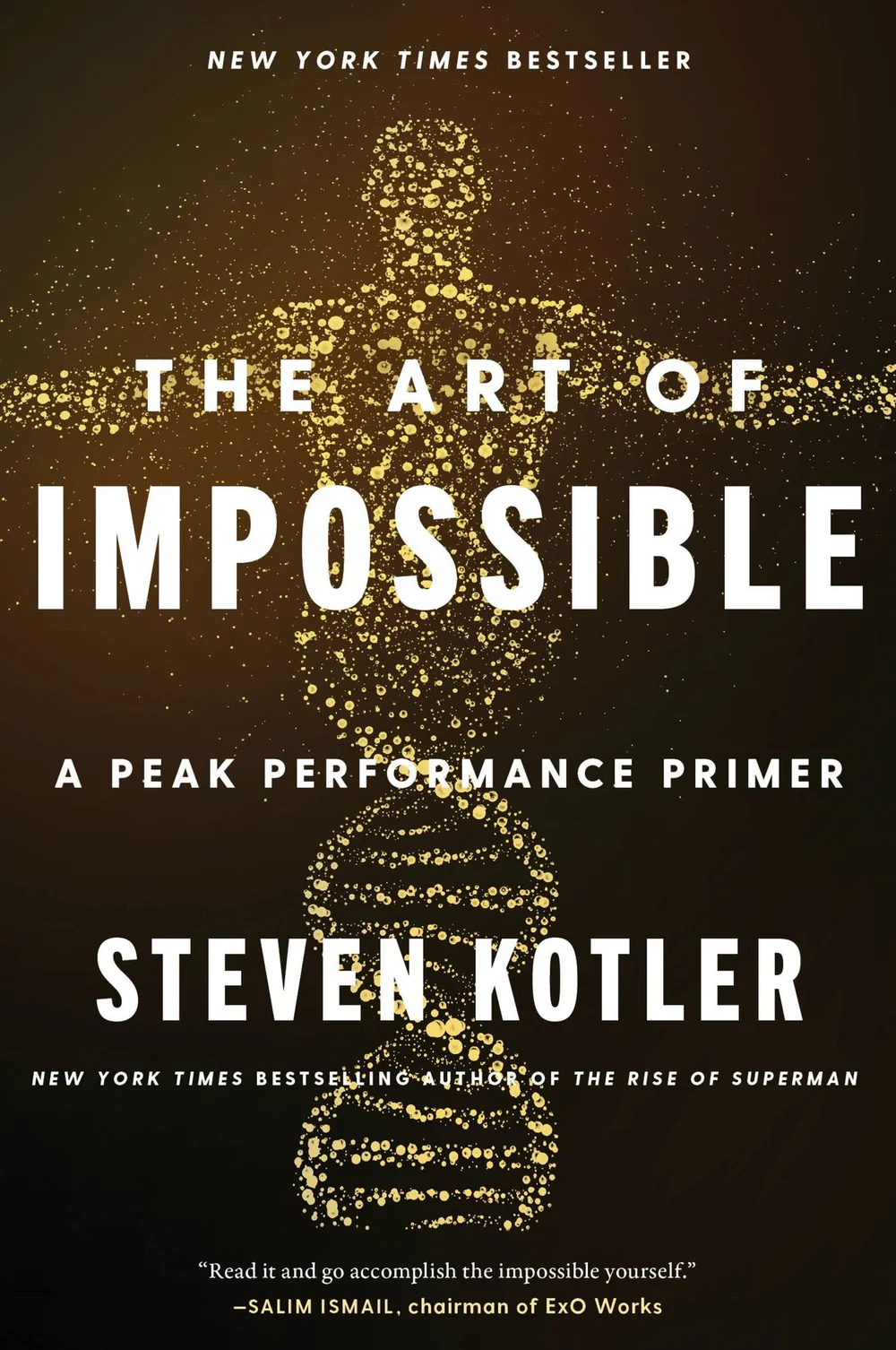
Official description: Bestselling author and peak performance expert Steven Kotler decodes the secrets of those elite performers—athletes, artists, scientists, CEOs and more—who have changed our definition of the possible, teaching us how we too can stretch far beyond our capabilities, making impossible dreams much more attainable for all of us.
What does it take to accomplish the impossible? What does it take to shatter our limitations, exceed our expectations, and turn our biggest dreams into our most recent achievements?
We are capable of so much more than we know—that’s the message at the core of The Art of Impossible. Building upon cutting-edge neuroscience and over twenty years of research, bestselling author, peak performance expert and Executive Director of the Flow Research Collective, Steven Kotler lays out a neuroscience-backed blueprint for extreme performance improvement. If you want to aim high, this is the playbook to make it happen!
Inspirational and aspirational, pragmatic and accessible, The Art of Impossible is a life-changing experience disguised as a how-to manual for high achievement that anyone can use to shoot for the stars... space-suit, not included.
The Art of Impossible is a practical playbook that gives you the tools to accomplish your own lowercase “i” impossibles, teaching you how to:
- Master Motivation and Grit: Go beyond sheer willpower by stacking intrinsic drivers like passion and purpose to build the habit of ferocity needed to overcome any obstacle.
- Accelerate Your Learning: Discover the five essential steps for mastering new skills and information, allowing you to stay ahead of the curve and continuously improve.
- Unlock Creativity on Demand: Learn to harness the three key brain networks that drive innovation, turning novel ideas into world-changing solutions.
- Harness the Flow State: Tap into the neurobiological secret of peak performance to amplify focus, productivity, and creativity, cutting the time it takes to achieve mastery in half.
Flow: The Psychology of Optimal Experience by Mihaly Csikszentmihalyi
Book page: Flow: The Psychology of Optimal Experience

Official description: Legendary psychologist Mihaly Csikszentmihalyi's famous investigations of "optimal experience" have revealed that what makes an experience genuinely satisfying is a state of consciousness called flow. During flow, people typically experience deep enjoyment, creativity, and a total involvement with life. In this new edition of his groundbreaking classic work on personal growth, Csikszentmihalyi ("the leading researcher into ‘flow states’" —Newsweek) demonstrates the ways this positive state can be controlled, not just left to chance. Flow: The Psychology of Optimal Experience teaches how, by ordering the information that enters our consciousness, we can discover true happiness, learn to control consciousness, unlock our potential, and greatly improve the quality of our lives.
In this landmark work on the psychology of optimal experience, you will learn how to transform your life:
A State of Consciousness Called Flow: Discover flow, the state of total involvement where you experience deep enjoyment, creativity, and lose track of time.
Enjoyment and the Quality of Life: Learn how to go beyond simple pleasure to find true enjoyment by ordering the information that enters your consciousness.
Work as Flow: Transform your daily work into a more rewarding and enjoyable activity by structuring it to produce optimal experiences.
The Autotelic Experience: Find purpose and meaning not in external rewards, but in the process of living itself, turning any activity into an end in itself.
The Rise of Superman: Decoding the Science of Ultimate Human Performance by Steven Kotler
Book page: The Rise of Superman: Decoding the Science of Ultimate Human Performance
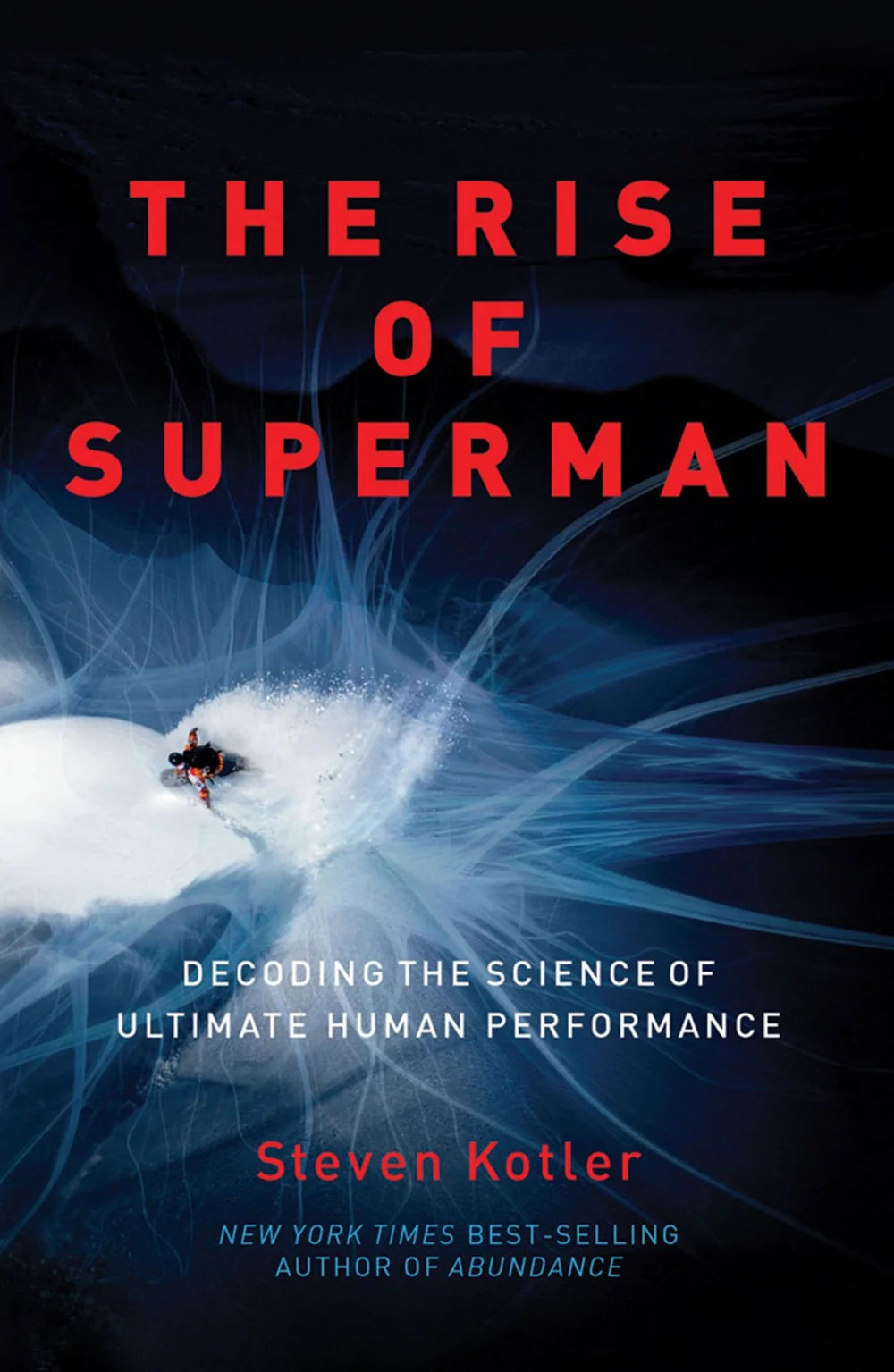
Official description: THE RISE OF SUPERMAN unlocks the code of ultimate human performance—bridging the gap between the extreme and the mainstream.
Drawing on over 15 years of research, including first-hand reporting with dozens of top action and adventure athletes (Laird Hamilton, Travis Rice, Ian Walsh, Danny Way, Dean Potter, among many others), RISE explores the frontier science of “flow,” an optimal state of consciousness in which we perform and feel our best
By using “impossible” athletic feats as case studies, RISE deciphers what these athletes are doing to harness flow so successfully and shows us how to apply this knowledge across all domains in society.
In other words, despite the unusual “them” at the center of this book, this story is really about “us.” You and me. Who doesn’t want to know how to be their best when it matters most? To be more creative, more contented, more consumed? To soar and not to sink? As the deeds of these athletes prove, if we can master flow, there are no limits to what we can accomplish.
Finding Flow: The Psychology of Engagement with Everyday Life by Mihaly Csikszentmihalyi
Book page: Finding Flow: The Psychology of Engagement with Everyday Life

Official description: What makes a good life? Is it money? An important job? Leisure time? Mihaly Csikszentmihalyi believes our obsessive focus on such measures has led us astray. Work fills our days with anxiety and pressure, so that during our free time, we tend to live in boredom, watching TV or absorbed by our phones.
What are we missing? To answer this question, Csikszentmihalyi studied thousands of people, and he found the key. People are happiest when they challenge themselves with tasks that demand a high degree of skill and commitment, and which are undertaken for their own sake. Instead of watching television, play the piano. Take a routine chore and figure out how to do it better, faster, more efficiently.
In short, learn the hidden power of complete engagement, a psychological state the author calls flow. Though they appear simple, the lessons in Finding Flow are life-changing.