
Joy😂, Gratitude🙏, Love❤️, Satisfaction😌, and Hope🤞
-
Keeping a gratitude list lifts your mood: In a randomized study, people assigned to list things they were grateful for (weekly or daily) showed heightened well-being across several measures compared to those listing hassles or neutral events; the effect on positive affect was the most robust finding. Daily journalers also reported more alertness, enthusiasm, and energy, and were more likely to have helped someone with a personal problem. ("Counting blessings versus burdens: an experimental investigation of gratitude and subjective well-being in daily life," Journal of Personality and Social Psychology, 2003)
-
People asked to write and deliver a letter of gratitude were happier for the next month: "Participants were given one week to write and then deliver a letter of gratitude in person to someone who had been especially kind to them but had never been properly thanked. ...Participants in the gratitude visit condition were happier and less depressed. In fact, participants in the gratitude visit condition showed the largest positive changes in the whole study. This boost in happiness and decrease in depressive symptoms were maintained at follow-up assessments one week and one month later. But by three months, participants in the gratitude visit condition were no happier or less depressed than they had been at baseline." ("Positive Psychology Progress: Empirical Validation of Interventions", American Psychologist, 2005)
-
Being nice to others is its own reward: "[A] systematic review and meta-analysis of the experimental evidence that kindness interventions (for example, performing ‘random acts of kindness’) boost subjective well-being... revealed that the overall effect of kindness on the well-being of the actor is small-to-medium (δ = 0.28)." ("Happy to help? A systematic review and meta-analysis of the effects of performing acts of kindness on the well-being of the actor," Journal of Experimental Social Psychology, 2018)
-
Hope is a measurably positive force in your life: "A greater sense of hope was associated with: better physical health and health behavior outcomes on some indicators (e.g., reduced risk of all cause-mortality, fewer number of chronic conditions, lower risk of cancer, and fewer sleep problems), higher psychological well-being (e.g., increased positive affect, life satisfaction, and purpose in life), lower psychological distress, and better social well-being." ("The role of Hope in subsequent health and well-being for older adults: An outcome-wide longitudinal approach," Global Epidemiology, 2020) Correlation does not prove causation, but we can hope!
-
Psychology is embroiled in a replication crisis, so be skeptical of even "scientific" findings: "We conducted replications of 100 experimental and correlational studies published in three psychology journals using high-powered designs and original materials when available.... Ninety-seven percent of original studies had significant results (P < .05). Thirty-six percent of replications had significant results." ("Estimating the reproducibility of psychological science," Science, 2015) Researchers are rewarded for publishing, and studies that find nothing don't get published. Experiments that find nothing are either discarded silently or "massaged" until they show an effect. In theory, meta-analyses analyzing a collection of similar studies are less error-prone, but the widely believed and frequently "replicated" theory of "ego depletion" has arguably been debunked as junk science, and meta-analysis failed to catch the methodological flaws. As in the subprime mortgage crisis, when you aggregate bad experiments, you still have a pile of junk experiments. (Daniel Engber"Everything Is Crumbling: An influential psychological theory, borne out in hundreds of experiments, may have just been debunked. How can so many scientists have been so wrong?," Slate, 6 March 2016)

📽️ Videos
How Stoicism Can Make You Happier: Daily Stoic
Want to Be Happy? Be Grateful: Mindset Mentor Podcast
Give up on happiness. Go hard at wonder: Monica Parker
Helping others makes us happier -- but it matters how we do it: Elizabeth Dunn on TED
How to grow deeply happy: Jonny Thomson
The Anti-Aging Habit That Adds 7.5 Extra Years of Life: Doctor Alex
*Why humans are surprisingly bad at being happy: Laurie Santos
The art and science of happiness: Arthur Brooks at TEDxKC
Live More by Doing Less: The Philosophy of Slow Living: Einzelgänger
7 Stoic Keys To Happiness: Daily Stoic
📰 Articles
- Oliver Burkeman's last column: the eight secrets to a (fairly) fulfilled life: SOURCE
- How Can We Feel Loved If We Don’t Feel Known?: Sonja Lyubormirsky & Harry Reis
- The Real Roots of Midlife Crisis: Jonathan Rauch
- World Happiness Report 2026: World Happiness Report
- Seeking a Science of Awe: A Conversation with Dacher Keltner: Behavioral Scientist
- Your deepest regrets help you see yourself more clearly: Psyche
- Mastering Modern Love: Logan Ury on Building Better Relationships through Behavioral Science: Christina Gravert
- The Pleasures of Pain and the Pains of Pleasure: Paul Bloom
📚 Books
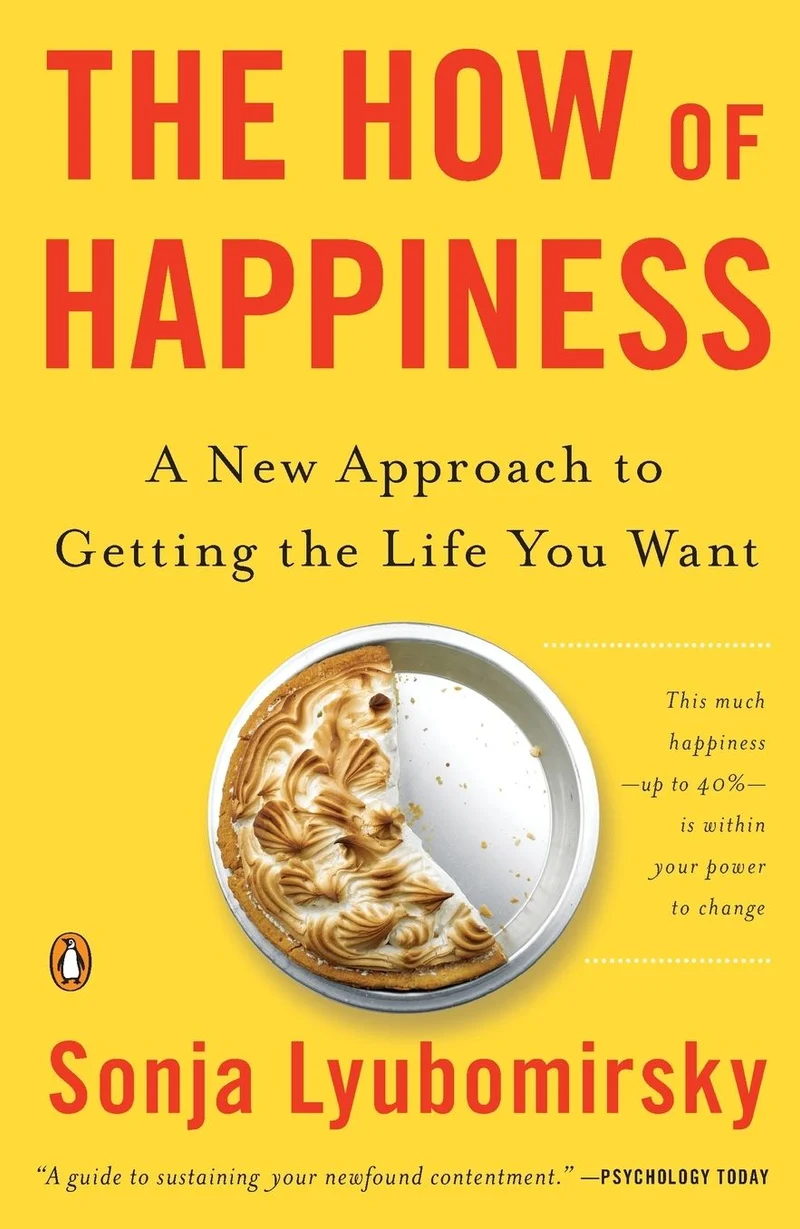
The How of Happiness: A New Approach to Getting the Life You Want by Sonja Lyubomirsky
Book page | Barnes & Noble | Amazon
Official description: Learn how to achieve the happiness you deserve
"A guide to sustaining your newfound contentment." —Psychology Today
"Lyubomirsky's central point is clear: a significant portion of what is called happiness... is up for grabs. Taking some pages out of the positive psychology playbook, she coaches readers on how to snag it." —The New York Review of Books
You see here a different kind of happiness book. The How of Happiness is a comprehensive guide to understanding the elements of happiness based on years of groundbreaking scientific research. It is also a practical, empowering, and easy-to-follow workbook, incorporating happiness strategies, excercises in new ways of thinking, and quizzes for understanding our individuality, all in an effort to help us realize our innate potential for joy and ways to sustain it in our lives. Drawing upon years of pioneering research with thousands of men and women, The How of Happiness is both a powerful contribution to the field of positive psychology and a gift to people who have sought to take their happiness into their own hands.
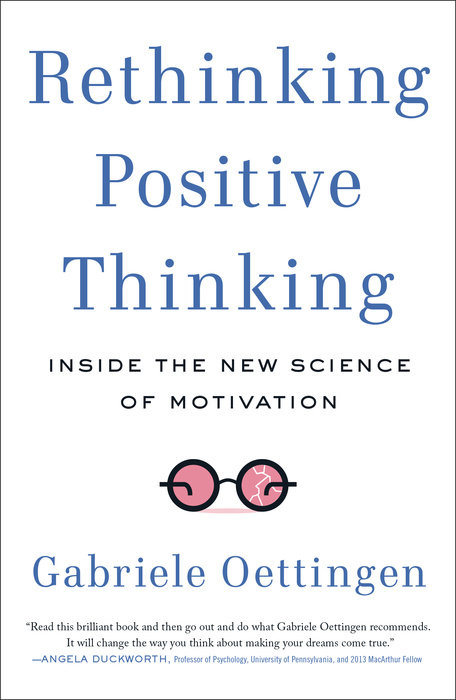
Rethinking Positive Thinking: Inside the New Science of Motivation: Gabriele Oettingen
Book page | Hoopla | Barnes & Noble | Amazon
Official description: “The solution isn’t to do away with dreaming and positive thinking. Rather, it’s making the most of our fantasies by brushing them up against the very thing most of us are taught to ignore or diminish: the obstacles that stand in our way.”
So often in our day-to-day lives we’re inundated with advice to “think positively.” From pop music to political speeches to commercials, the general message is the same: look on the bright side, be optimistic in the face of adversity, and focus on your dreams. And whether we’re trying to motivate ourselves to lose weight, snag a promotion at work, or run a marathon, we’re told time and time again that focusing on fulfilling our wishes will make them come true.
Gabriele Oettingen draws on more than twenty years of research in the science of human motivation to reveal why the conventional wisdom falls short. The obstacles that we think prevent us from realizing our deepest wishes can actually lead to their fulfillment. Starry-eyed dreaming isn’t all it’s cracked up to be, and as it turns out, dreamers are not often doers.
While optimism can help us alleviate immediate suffering and persevere in challenging times, merely dreaming about the future actually makes people more frustrated and unhappy over the long term and less likely to achieve their goals. In fact, the pleasure we gain from positive fantasies allows us to fulfill our wishes virtually, sapping our energy to perform the hard work of meeting challenges and achieving goals in real life.
Based on her groundbreaking research and large-scale scientific studies, Oettingen introduces a new way to visualize the future, calledmental contrasting. It combines focusing on our dreams with visualizing the obstacles that stand in our way. By experiencing our dreams in our minds and facing reality we can address our fears, make concrete plans, and gain energy to take action.
In Rethinking Positive Thinking, Oettingen applies mental contrasting to three key areas of personal change— becoming healthier, nurturing personal and professional relationships, and performing better at work. She introduces readers to the key phases of mental contrasting using a proven four-step process called WOOP—Wish, Outcome, Obstacle, Plan—and offers advice and exercises on how to best apply this method to daily life. Through mental contrasting, people in Oettingen’s studies have become significantly more motivated to quit smoking, lose weight, get better grades, sustain fulfilling relationships, and negotiate more effectively in business situations.
Whether you are unhappy and struggling with serious problems or you just want to improve, discover, and explore new opportunities, this book will deepen your ideas about human motivation and help you boldly chart a new path ahead.
Stumbling on Happiness by Daniel Gilbert
Book page | Barnes & Noble | Amazon
Official description: Bringing to life scientific research in psychology, cognitive neuroscience, philosophy, and behavioral economics, this witty, accessible book reveals what scientists have discovered about the uniquely human ability to imagine the future, and about our capacity to predict how much we will like it when we get there.
• Why are lovers quicker to forgive their partners for infidelity than for leaving dirty dishes in the sink?
• Why will sighted people pay more to avoid going blind than blind people will pay to regain their sight?
• Why do dining companions insist on ordering different meals instead of getting what they really want?
• Why do pigeons seem to have such excellent aim; why can’t we remember one song while listening to another; and why does the line at the grocery store always slow down the moment we join it?
In this brilliant book, renowned Harvard psychologist Daniel Gilbert describes the foibles of imagination and illusions of foresight that cause each of us to misconceive our tomorrows and misestimate our satisfactions. With penetrating insight and sparkling prose, Gilbert explains why we seem to know so little about the hearts and minds of the people we are about to become.